Occupational illness and industrial pollution
Blood ShotOccupational illness and industrial pollution form a continuous history in the novel: toxic exposure begins as an accepted cost of manufacturing, becomes a disputed legal claim when workers fall ill, and is finally made visible through medical records gathered over decades. The story connects the changing standards at Humboldt Chemical’s Xerxes plant to the lives of individual employees, the limits of workers’ compensation, and the wider struggle over who bears the costs of industrial development.
Industrial setting and changing knowledge
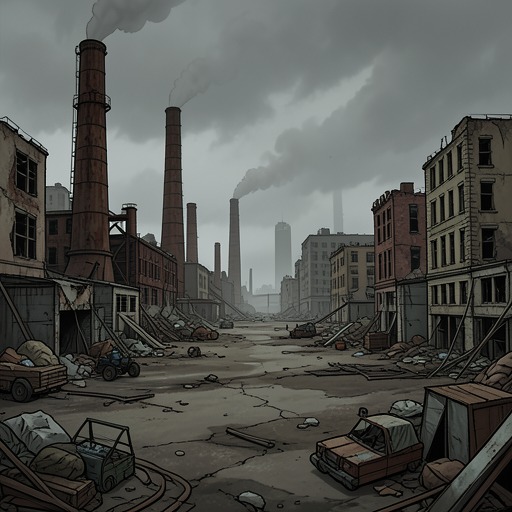
South Chicago’s industrial landscape carries the material history of that struggle. On the drive south along Route 41, Lake Michigan and the high-rises give way to the weed-choked yards of USX South Works, with industrial structures visible through the February air. The neighborhood’s houses remain carefully kept, but its factories tell a different story: South Works is on strike, Wisconsin Steel stands padlocked and rusting, and a once-busy district has been diminished by industrial decline. The narrator remembers when eighteen thousand men went each day from the neighborhood’s homes to the steelworks, the Ford assembly plant, or the Xerxes solvent factory. That remembered scale of employment gives the later illness claims a community-wide context without making every neighborhood condition evidence of a single cause.
Xerxine, the solvent manufactured at the Xerxes plant, is described as a chlorinated hydrocarbon, generally made by adding chlorine to ethylene gas. It could be used to clean oil from sheet metal, paint, and other materials. The danger arose during manufacture: workers who breathed the vapors could suffer harm to the liver, kidneys, and central nervous system. When Humboldt Chemical began making Xerxine in the 1950s, the relevant health risks were not yet understood, and the plant did not carefully control the amount of chlorinated vapor in the air. The account distinguishes lack of knowledge from lack of consequence: the workers’ exposure occurred even before the company’s practices changed.
By the 1960s and 1970s, researchers including Irving Selikoff were investigating industrial pollution and worker health. Evidence that chemicals such as Xerxine could be toxic at low concentrations led to greater controls. In the late 1970s, the U.S. Environmental Protection Agency issued a Xerxine standard of 50 parts per million. Xerxes installed air scrubbers, enclosed pipes more effectively, and brought measured concentrations down to the federal limit. Those changes mark a significant shift in industrial practice, but they could not undo earlier exposure. The conflict at the center of the workers’ claims is precisely that the standard and the improved controls arrived after some employees had already spent years in the plant.
Workers and the disputed causes of illness
Pankowski and Steve Ferraro approached their lawyer in early 1983, both seriously ill after long employment at Humboldt Chemical. Ferraro had worked there since 1959 and Pankowski since 1961. They had stopped working when their conditions became too severe, about two years earlier, and their lawyer believed they may not have been told that disability benefits were available. They sought workers’ compensation for conditions they believed were work-related; the case mattered urgently because both men were gravely ill, and a successful claim after either man’s death could have provided an indemnity payment to the family.
Humboldt Chemical resisted an agreement, and the lawyer filed suit. The company challenged whether Xerxine exposure, rather than smoking or the polluted air of South Chicago, had caused the illnesses. It also argued that the men had worked at the plant before Xerxine’s toxicity was known, and that the company should not be held responsible for operating according to the medical knowledge available at the time. Both workers’ smoking was relevant to that dispute; Pankowski also drank heavily. The lawyer accepted that the evidence then available was not enough to win and that an appellate lawyer saw no basis for an appeal. Yet he remained convinced that the men deserved compensation for the years they had given the company, especially because their work may have contributed to their illnesses.
The evidentiary problem is not treated as a simple contest between a known poison and an innocent alternative. The lawsuit exposed how multiple possible causes could make individual responsibility difficult to establish, while the legal defense relied on the limits of what was known during the period of exposure. A threatening telephone call after the case, made while an appeal was being considered, intensified the pressure. It referred generally to the dangers of using the appellate system rather than naming the lawsuit. The lawyer pushed to build an appeal but could not find a legal route forward.
Medical records and the long view
Later, a specialist’s review of the notebooks kept by Dr. Chigwell changed what could be shown. The records included blood histories for Louisa Djiak from 1963 to 1982 and Ferraro from 1957 to 1982, as well as records for approximately five hundred other employees at the Xerxes plant from 1955 to 1982. Changes in creatine, blood urea nitrogen, bilirubin, hematocrit, hemoglobin, and white blood count were consistent with developing kidney, liver, and bone-marrow dysfunction. The breadth and duration of the records made them more than isolated recollections of exposure: they preserved repeated measurements across workers and years.
Louisa’s record also showed how illness could remain unrecognized in ordinary life. The medical summary placed noticeable renal damage as early as 1967 and severe damage by 1969. Around 1979, she began experiencing diffuse symptoms, including itching, fatigue, and headaches, but thought they might be related to menopause and did not consult a doctor. She first saw her physician in 1984, after her daughter insisted; he diagnosed chronic renal failure, which later progressed to an acute stage. Other complications made her a poor candidate for a transplant. Ferraro’s records ended with his death from aplastic anemia in 1983. The specialist’s analysis connected the blood changes to patterns consistent with Xerxine exposure, while the medical histories made the timing and consequences of illness harder to dismiss as a single late diagnosis.
The records do not erase the earlier problem of distinguishing occupational exposure from other risks. Rather, they alter the evidentiary picture: documented changes across a large employee group and over many years offer a different basis for assessing the company’s history than the evidence available in the first lawsuit. The novel sets the measured, accumulating record against the legal defense that no one could prove which exposure had caused which illness.
Community action and collective consequences
The same industrial setting also shapes a separate effort to address pollution before it enters the ground. Caroline Djiak explains that the proposed solvent-recycling plant has funding, a site, and specifications that have passed the EPA tests considered by its proponents. Xerxes and Glow-Rite are potential customers, and the project promises about one hundred local jobs while reducing waste. Yet the proposal is kept off a zoning-board agenda despite being filed in time. The stated objection is that it lacks complete community backing; Nancy Cleghorn challenges that claim, saying the community supports it and that the board’s chairman, Martin O’Gara, has not identified a meaningful reason to deny a hearing. The episode places environmental decision-making alongside employment and political access: the community is asked to bear industrial risks, but its proposed response does not automatically receive a hearing.
Earlier opposition to Steve Dresberg’s proposed PCB incinerator had also brought threats. Caroline and Nancy testified that they had received death threats because they opposed it, although their account of those threats had not been included in Caroline’s initial statement to the police. Their experience shows that environmental advocacy in South Chicago involves more than technical arguments about pollution; it can also expose organizers to intimidation and force them to revisit past threats when another activist is killed.
The later medical evidence creates a possible route from individual claims to collective action. When V. I. Warshawski approaches Frederick Manheim about organizing a case for hundreds of former Xerxes employees, and perhaps current workers, she stresses the scale of the undertaking: his small practice would need researchers, associates, and paralegals, and the work could occupy the next decade. Manheim agrees to consider it, saying he could not live with himself if he declined a chance to pursue a case that might now be winnable. The shift from two sick workers whose suit failed to the prospect of claims by hundreds gives the notebooks their broader consequence.
Narrative significance
The novel makes industrial pollution legible through a contrast in time. Factory controls improve when knowledge and standards change, but the bodily effects of earlier exposure continue to emerge long afterward. Individual workers encounter a compensation system that demands proof while illness may have several plausible causes; records gathered over decades help make a pattern visible without simplifying that problem. Meanwhile, the proposed recycling plant and the threats faced by its opponents show that pollution is also a matter of community power: who can shape industrial decisions, whose evidence is heard, and who must live with the consequences. Occupational illness is therefore not presented as a private misfortune separate from the economy around it. It is the delayed human cost of production, and the struggle to document that cost becomes inseparable from the struggle to obtain recognition and remedy.